Monday, August 19, 2013
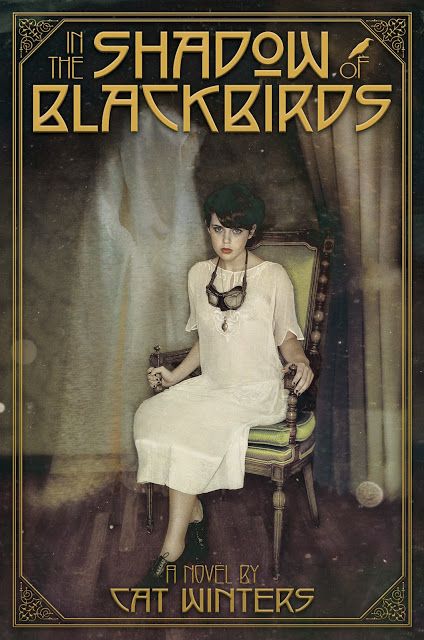
Featuring haunting archival early-twentieth-century photographs, this is a tense, romantic story set in a past that is eerily like our own time.
Review: In the Shadow of Blackbirds is a creepy, melancholy historical novel that captures a sense of death as omnipresent, likely a not-uncommon feeling to those living in the United States in 1918. It's interesting that the novel not only focuses on the effects of WWI but also on the flu pandemic, a topic I don't believe I've ever seen addressed in fiction set in this time period (aside from Downton Abbey Season 2). The sad yet creepy atmosphere of the novel is its strongest feature: bodies are piled in the streets, everyone wears masks, and even leaving your home can be life threatening. Meanwhile more and more young men are sent overseas and return home changed and broken, if they return home at all. It's no wonder people became preoccupied with death and the hope of an afterlife.
In fact I found the real-world historical elements so compelling that when the supernatural made an appearance it felt like an intrusion. However the central mystery was interesting and served as a way of tying in some poetry from WWI. The photographs were a nice touch, although not as frequent or as plot relevant as those found in Miss Peregrine's Home for Peculiar Children. Overall I enjoyed this story for the mystery and the fact that Cat Winters had clearly put a lot of research behind it.
Character wise, there was one thing that bothered me a little. I liked that Mary Shelley Black was smart and knew it, and took action to solve the mystery and discover the true fate of Stephen, the boy she lost in the war. However I did feel she suffered a little from a syndrome I like to call Character Displaced In Time, where a character in a time period with a different set of social norms holds the views of a kid born in the '90s. This is usually so the reader can find the character more relatable. Of course there were progressives in that time, and I don't disagree with Mary in general but I disliked the way she looked down on every other female character for not being as awesome as she. From patronizing her aunt who works in a shipyard to criticizing the spiritualist's dress to being contemptuous of volunteers at a nursing home for soldiers based on a photograph of them pouring tea, Mary Shelley had a bit of an attitude I found hard to stomach. It which threw me out of the story every time it came up and lessoned my enjoyment of the novel overall.
3.5 haunted photographs.
Subscribe to:
Post Comments (Atom)
Monday, August 19, 2013
Review: In the Shadow of Blackbirds
Featuring haunting archival early-twentieth-century photographs, this is a tense, romantic story set in a past that is eerily like our own time.
Review: In the Shadow of Blackbirds is a creepy, melancholy historical novel that captures a sense of death as omnipresent, likely a not-uncommon feeling to those living in the United States in 1918. It's interesting that the novel not only focuses on the effects of WWI but also on the flu pandemic, a topic I don't believe I've ever seen addressed in fiction set in this time period (aside from Downton Abbey Season 2). The sad yet creepy atmosphere of the novel is its strongest feature: bodies are piled in the streets, everyone wears masks, and even leaving your home can be life threatening. Meanwhile more and more young men are sent overseas and return home changed and broken, if they return home at all. It's no wonder people became preoccupied with death and the hope of an afterlife.
In fact I found the real-world historical elements so compelling that when the supernatural made an appearance it felt like an intrusion. However the central mystery was interesting and served as a way of tying in some poetry from WWI. The photographs were a nice touch, although not as frequent or as plot relevant as those found in Miss Peregrine's Home for Peculiar Children. Overall I enjoyed this story for the mystery and the fact that Cat Winters had clearly put a lot of research behind it.
Character wise, there was one thing that bothered me a little. I liked that Mary Shelley Black was smart and knew it, and took action to solve the mystery and discover the true fate of Stephen, the boy she lost in the war. However I did feel she suffered a little from a syndrome I like to call Character Displaced In Time, where a character in a time period with a different set of social norms holds the views of a kid born in the '90s. This is usually so the reader can find the character more relatable. Of course there were progressives in that time, and I don't disagree with Mary in general but I disliked the way she looked down on every other female character for not being as awesome as she. From patronizing her aunt who works in a shipyard to criticizing the spiritualist's dress to being contemptuous of volunteers at a nursing home for soldiers based on a photograph of them pouring tea, Mary Shelley had a bit of an attitude I found hard to stomach. It which threw me out of the story every time it came up and lessoned my enjoyment of the novel overall.
3.5 haunted photographs.
0 comments:
Post a Comment
Thank you, comments are appreciated :)